Pile Driving Noise Ordinance Compliance: 7 Major US Cities Reference Guide 2026
Pile driving noise regulation in the United States is set at the city or county level, not by a single federal standard. Each jurisdiction defines its own permitted construction hours, decibel thresholds, and measurement methodology, and contractors mobilizing between markets must confirm the applicable local code before scheduling impact or vibratory pile work — an ordinance that applied on a prior project in one city will not necessarily apply in another. This guide summarizes the confirmed regulatory framework in seven major US construction markets, drawn from current municipal code and city agency publications, and outlines how vibratory hammer selection supports compliance across all of them.
New York City — Local Law 113 (NYC Noise Code)
Enforced by the Department of Environmental Protection (DEP) under Title 24 of the NYC Administrative Code and the Construction Noise Regulation in Title 15 RCNY Chapter 28. Standard construction hours are 7:00 AM–6:00 PM on weekdays; work outside this window requires an After Hours Variance (AHV) from the Department of Buildings. Street construction noise, including pile driving, is limited to 85 dBA measured at or beyond the property line or 50 feet from the source. Large projects must file an electronic noise mitigation plan, and contractors are required to use Best Available Noise Control Technology (BANT) — meaning a contractor can be cited for using louder equipment than necessary even while technically within the decibel limit. During Tappan Zee Bridge construction, sheet pile driving was shut down by state officials after readings exceeded the 90 dBA limit set in the project contract, following sustained resident complaints.
Seattle — Seattle Municipal Code Chapter 25.08
Enforced by the Seattle Department of Construction and Inspections (SDCI). General construction is permitted 7:00 AM–10:00 PM weekdays and 9:00 AM–10:00 PM weekends and legal holidays; multifamily and neighborhood commercial zones narrow to 7:00 AM–7:00 PM weekdays. Impact construction — a category that explicitly names pile drivers, jackhammers, hoe rams, and shaking auger heads — is restricted to the narrowest window among all cities in this guide: 8:00 AM–5:00 PM weekdays and 9:00 AM–5:00 PM weekends and legal holidays. Seattle’s general residential noise standard is 75 dBA averaged over one hour at 50 feet, one of the few cities using an averaged rather than instantaneous measurement.
Boston — Regulations for the Control of Noise / APCC
Split between Boston Municipal Code Chapter 16 Section 26 and the Air Pollution Control Commission (APCC) construction noise regulations. Standard hours are 7:00 AM–6:00 PM weekdays; an ISD Off Hours Permit is required outside this window. The Municipal Code’s general threshold is 50 dBA between 11:00 PM–7:00 AM or 70 dBA at other hours, measured at the residential lot line. The APCC’s separate zoning table sets 60 dBA daytime / 50 dBA other times for residential areas, with an L10 limit of 75 dBA and a maximum of 86 dBA at residential/institutional properties, measured 50 feet from the device. Notably, APCC Regulation 3.4 exempts impact devices — including pile drivers — from these specific numeric limits, so pile driving in Boston is controlled primarily through permitted hours rather than a hard decibel ceiling.
Chicago — Municipal Code Chapter 8-32, Noise and Vibration Control
Chicago’s ordinance defines the construction curfew directly around pile drivers: Section 8-32 prohibits operating any pile driver, shovel, hammer, derrick, hoist, tractor, or roller within 600 feet of a residential building or hospital between 8:00 PM and 8:00 AM. Commercial construction is generally permitted 7:00 AM (setup) to 8:00 PM (loud machinery) on weekdays and 8:00 AM–5:00 PM on Saturdays, with work generally prohibited on Sundays and holidays absent a permit. Chicago measures general noise nuisance using “average conversational level” rather than a fixed decibel figure, but the pile-driver curfew itself is time-based, not decibel-based. First violations carry penalties of $1,000–$2,500, escalating to $5,000–$10,000 for repeat violations within a year, with each day of continued violation treated as a separate offense.
San Francisco — Police Code Article 29
Enforced by the Department of Building Inspection (DBI), Department of Public Health, and SFPD. Section 2908 prohibits construction between 8:00 PM and 7:00 AM absent a Night Noise Permit from Public Works. Section 2907(b) limits powered construction equipment to 80 dBA measured at 100 feet, and Section 2909 additionally prohibits noise exceeding ambient by more than 5 dBA at the nearest property line during restricted hours. Night Noise Permits, when granted, still cap noise at 5 dBA above ambient after 10:00 PM. For pile driving specifically, several Bay Area jurisdictions (including South San Francisco) additionally require a vibration analysis by a qualified acoustical consultant for construction within 100 feet of a residential or other sensitive receptor.
Houston — Code of Ordinances Chapter 30, Noise and Sound
Houston has no fixed citywide construction hour restriction comparable to the other cities in this guide — general construction and demolition activity is instead governed directly by decibel limits at the receiving property: 65 dBA daytime and 58 dBA nighttime (10:01 PM–7:59 AM) at residential receiving properties. State law separately classifies noise exceeding 85 dBA as unreasonable once the source has been notified of a complaint by law enforcement. This decibel-first structure — rather than a fixed curfew — means Houston pile driving compliance is managed primarily through real-time noise monitoring at the nearest residence, making equipment with lower baseline emission and real-time amplitude control operationally significant for maintaining continuous compliance through the full working day rather than only during defined hours.
Washington, DC — DCMR Title 20, Chapter 27–28
Enforced under the DC Noise Control Act of 1977. General construction hours are 7:00 AM–7:00 PM Monday through Saturday; an after-hours permit is required outside this window, and construction noise in residential, special purpose, or waterfront zones is prohibited entirely on Sundays and legal holidays. DC’s regulation contains a specific carve-out relevant to piling contractors: from 7:00 AM–7:00 PM on weekdays, construction and demolition noise is capped at 80 dBA — but this cap explicitly excludes pile driver devices, which are instead regulated through the hours restriction and the general nuisance provisions rather than a specific numeric limit during the day.
City-by-City Comparison
Across these seven cities, three regulatory patterns repeat: (1) impact and pile-driving equipment is frequently singled out for either a stricter operating window (Seattle, Chicago) or an explicit exemption from the general decibel table in favor of hours-based control (Boston, DC); (2) measurement is almost always taken at the property line or a fixed distance (50–100 feet) from the source, not at the equipment itself, meaning the effective compliance margin depends on site geometry as much as hammer specification; and (3) several cities (NYC, San Francisco) impose an affirmative obligation to use the quietest technically suitable method, not merely to stay under the numeric limit.
Why Vibratory Hammer Selection Supports Compliance
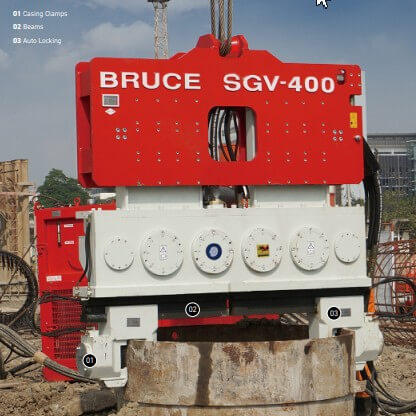
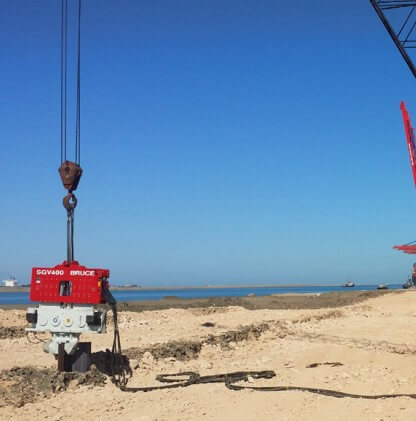
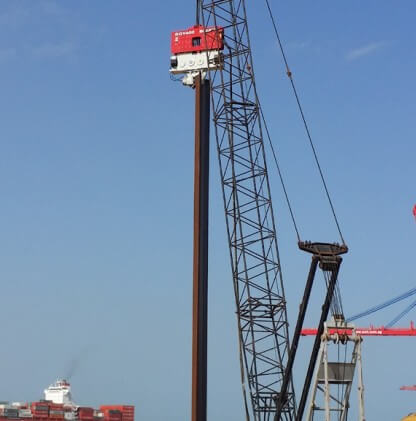
Vibratory hammers generate substantially lower baseline noise than diesel or air impact hammers at equivalent penetration depth, and the remote pendant’s real-time amplitude control allows the operator to reduce centrifugal force when a monitor approaches the local threshold — without stopping the drive cycle and losing a narrow permitted window such as Seattle’s 8:00 AM–5:00 PM impact-equipment restriction. In cities where impact devices are exempted from the numeric decibel table but still governed by hours and general nuisance provisions (Boston, DC), the lower baseline noise of vibratory driving reduces the practical risk of a nuisance complaint even where no specific dBA violation would technically occur. Because local ordinances are revised periodically — NYC’s limits tightened in 2018, Houston’s Chapter 30 was amended in 2022 — contractors should confirm current permitted hours and decibel thresholds with the local building or environmental department before mobilization rather than relying on a prior project’s approved conditions.
For technical specifications on suppressor isolation performance and amplitude control documentation to support local noise mitigation plan submissions, contact the BRUCE engineering desk at powerquip.co.kr/contact-us/. Full vibro hammer specifications are available at powerquip.co.kr/products/vibro-hammer/features-2/.
FAQ
Q: Is there a single federal noise limit for pile driving in the US?
No. Construction noise is regulated at the city or county level. The seven cities in this guide each apply different decibel thresholds, measurement points, and permitted hours, and contractors must confirm the specific local code before each project.
Q: Which city has the narrowest permitted hours for pile driving?
Seattle’s impact-construction category, which explicitly includes pile drivers, is limited to 8:00 AM–5:00 PM on weekdays and 9:00 AM–5:00 PM on weekends — narrower than Seattle’s own general construction hours and narrower than the other six cities covered here.
Q: Do Boston and Washington DC have a specific decibel limit for pile drivers?
No — both cities explicitly exempt pile drivers and other impact devices from their numeric construction noise tables (Boston APCC Regulation 3.4; DC DCMR 20-2701 exclusion). In both cities, pile driving is instead controlled through permitted working hours and general nuisance provisions.
Q: How is pile driving noise regulated in Houston, which has no fixed construction curfew?
Houston Chapter 30 caps noise at 65 dBA daytime and 58 dBA nighttime at the receiving residential property, rather than restricting construction to specific hours citywide. Compliance is managed through continuous decibel monitoring at the nearest residence rather than a fixed time window.